
 Click title or picture:
What is MWM?
MWM is an integrated STEM education program launched in 1993 with funding from the National Science Foundation.
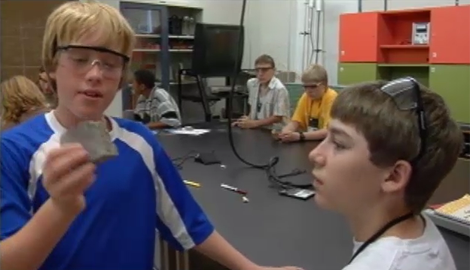
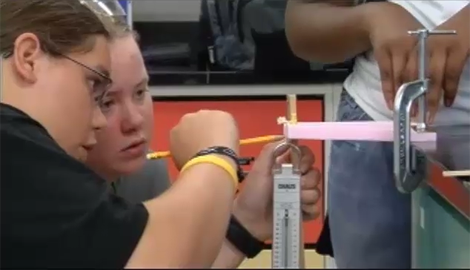
MWM uses hands-on “inquiry and design” activities to transfer the latest nanotechnology and materials science into middle and high school classrooms.
STEM teachers and university researchers have co-authored sixteen modules describing how materials and their properties can be used to solve global challenges and transform our everyday lives.
 MWM modules are easily inserted into any STEM course, can be taught in about 2 weeks, and are scalable from 6-12th grade.
Each module includes printed student manuals, a teacher’s guide, assessment questions, and a kit of classroom supplies.
Why Materials?
Materials science and engineering is ideally-suited for training a 21st century workforce!
First, it is interdisciplinary, with fundamental concepts that cut across physics, chemistry, biology, math and engineering.
Next, its many diverse applications – particularly nanotechnology - inspire students to think differently about STEM. Materials-based systems drive many technological applications, from mobile devices to medical diagnostic instruments, solar cells, smart grids, and cloud computing.
Importantly, it is a key economic driver! We have seen exponential growth in innovative technologies that are based on novel materials and their properties! Materials-driven nano, bio, and green technologies are solving global challenges in energy, environment, health and security. These emerging fields will drive a large fraction of the world economy in the next century!